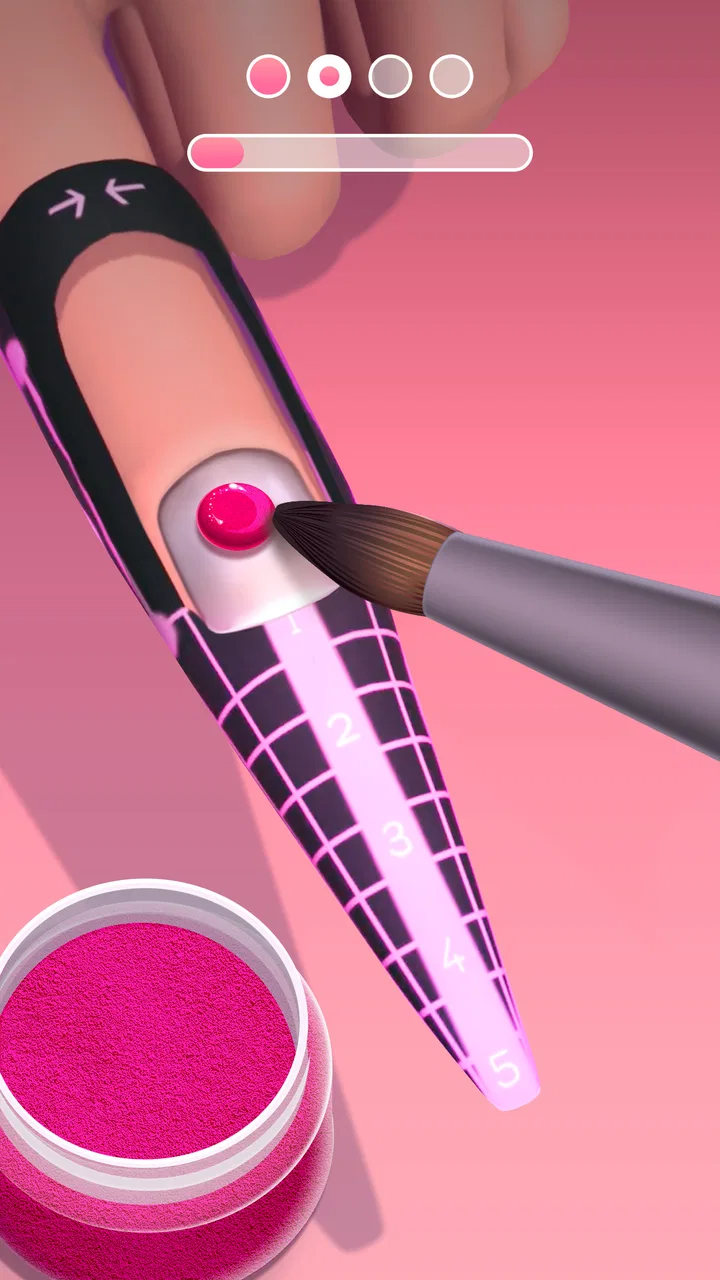
Acrylic Nails!
- 4.2
- Rating
- 100.00M
- Installs
- Free
- Price

 Analysis by App-foxy
I opened Acrylic Nails expecting a quick beauty game, and that is exactly where it feels most comfortable: short, visual sessions built around preparing and decorating nails. Developed by CrazyLabs LTD, this free simulation game sits between fashion play and casual salon care. Its simple premise makes it immediately approachable, but the real question is whether the goals, unlocks, and challenge are strong enough to keep the experience interesting after the first few designs.
My first impression was positive because the game does not ask me to learn a complicated interface before getting started. The focus is clear from the beginning: create acrylic nail looks, make choices about the appearance, and move through the salon-style activity one step at a time. The store’s short description calls it “Acrylic Nails,” while the fuller summary points toward crayola-inspired nail art, fashion, and beauty care. In practice, that combination gives the game a bright, playful identity rather than a realistic professional-salon tone.
The best reason to try it is its low-pressure creative loop. I can pick it up when I have a few spare minutes, complete a small sequence of nail-art tasks, and put it down without needing to remember a complicated story or long-term strategy. That makes it especially suitable for younger players and anyone who enjoys makeover games but does not want a demanding simulation.
You May Also Like

 AccuWeather: Weather Radar
AccuWeather Review: A Quick, Clear Forecast for Everyday Decisions
For everyday plans, the best forecast is the one you can understand quickly. AccuWeather makes rain timing, radar, and local conditions easy to act on, with a few trade-offs.

 Hill Climb Racing
Why Hill Climb Racing Still Turns Crashes Into One More Run
A tiny car, a bumpy hill and one more upgrade: Hill Climb Racing keeps resurfacing because its simple chaos makes every near-miss feel personal.

 AliExpress - Shopping App
AliExpress Makes Global Shopping Feel Personal, but Shoppers Bear the Risk
AliExpress turns a global marketplace into a pocket-sized discovery engine. Its reach is useful, its shopping loop compelling, and its trade-offs easy to miss.

 Lords Mobile: Kingdom Wars
Lords Mobile Is a Kingdom-Building Routine, Not a Quick Match
A case-by-case verdict on the building, battles, device demands, and social commitments that make Lords Mobile rewarding for some players and exhausting for others.

 PDF Scanner app - TapScanner
TapScanner Makes Paperwork Easier to Capture, Check, and Share
TapScanner makes scanning with a phone feel less like a rescue operation and more like a dependable step in getting work done. Its capture tools are useful, though not flawless.

 Block Blast!
 Shows How Much a Puzzle Game Can Leave Out
A quiet grid game shows why puzzle players increasingly value instant clarity, repeatable skill and low-pressure play—and where the genre still needs to catch up.
More From Our News Desk
View All News


How the goals and progression feel during play
I find the goals easiest to enjoy when I treat each design as a small project rather than a race through stages. Choosing a palette or aiming for a particular mood gives familiar steps a personal purpose, while the visible finish makes it simple to decide when a session feels complete. That balance between guided tasks and self-set goals is a useful way to judge whether the progression suits your play style.
Early goals are clear, visual, and easy to understand
The opening experience works because the goals are presented through the nail itself. Instead of explaining a large menu of systems, the game guides me toward the next visible salon action. The immediate objective is usually obvious: shape the nails, prepare them, add color or decoration, and finish the look. That visual structure is more effective than a long tutorial because I can see what needs attention.
This is where the game benefits from being a simulation aimed at casual play. I do not need prior knowledge of nail care, acrylic techniques, or fashion design. The game turns the process into a sequence of approachable decisions. For a child, that can feel like imaginative salon play. For an adult, it is closer to a relaxing digital craft activity than a serious beauty-management simulator.
The early goals also provide a useful sense of completion. Each finished set acts as a small reward in itself, particularly when the colors and decorations come together in a way I like. I found that the visual result matters more than any deep strategic outcome. The satisfaction comes from seeing a plain starting point become a finished design.
That simplicity is also the first trade-off. Players looking for complex salon management, customer personalities, inventory planning, or a detailed business layer will probably find the goals too narrow. The game is about performing and styling nail-art activities, not running a complete beauty business. It is important to set that expectation before downloading it.
Unlocks give the routine a reason to continue
As I continued, the appeal depended less on learning the controls and more on seeing what the next design or activity would bring. Unlocks are useful in this kind of game because they give the player a reason to complete another session even after the basic actions become familiar. A new visual possibility can be enough motivation when the experience is built around customization.
However, unlock-driven motivation works best when the player feels involved in earning the next option. If the main attraction is simply reaching the next stage, the routine can become predictable. I noticed that my interest was strongest when I was making an intentional design choice rather than merely following the next instruction. The game is more enjoyable when I treat each nail set as a small creative project instead of rushing through it as a checklist.
A practical way to get more from the progression is to pause before accepting the first obvious color combination. I tried thinking in terms of a theme—bright summer colors, a softer pastel look, or a deliberately mismatched set—and that made familiar actions feel more personal. The game does not need a complicated scoring system to support this approach; the player can create their own challenge by aiming for a particular visual result.
This is one of the more useful hidden strengths of the format: the game can be played either as a guided sequence or as a tiny design exercise. The first approach is better for quick entertainment, while the second gives the experience more staying power. Players who want complete freedom may still find the available choices limited compared with a dedicated drawing or design app, but the guided structure keeps the game accessible.
Progress signals are easy to read, but not especially deep
The clearest progress signal is the changing appearance of the nails. Preparation, color, and decoration are visible immediately, so I never had to wonder whether an action had made a difference. This is a strong design choice for a game aimed at Everyone, because visual feedback communicates more quickly than text-heavy instructions.
The finished result also helps separate one session from the next. Even when the underlying activity follows a familiar pattern, a different color or decorative choice makes the final screen feel distinct. That is enough to create a modest collection mindset: I wanted to see how the next design would look and whether it would offer a more interesting combination than the previous one.
At the same time, the progress is not the kind that will satisfy players who need detailed statistics, skill trees, or long-term optimization. There is no reason to approach the game like a competitive strategy title. My decisions affect the look and the immediate task, but they do not create a complex build or a permanent play style. The progression is visual and episodic rather than systemic.
That distinction helps explain the game’s broad reach. Its average rating is 4.3 from around 428 thousand ratings, and it has passed 100 million installs. Those figures suggest that the straightforward salon concept has found a large audience, but they should not be interpreted as proof that every player will enjoy the same level of depth. Popularity fits the game’s accessibility; it does not change its casual limits.
The difficulty curve stays gentle for a long time
I found the difficulty curve forgiving. The game is not built around punishing mistakes or demanding fast reactions. Its challenge comes from completing the sequence correctly and making choices that produce a pleasing result. That makes it comfortable for younger players, casual users, and anyone who wants a game that does not become stressful after a few minutes.
The gentle curve is particularly welcome when the game is used as a short break. I could play without preparing for a difficult level or worrying about losing a long run. If I made a design decision I did not love, the consequence felt small, which encouraged experimentation rather than cautious play.
The downside is that experienced simulation players may not feel much pressure to improve. There is little reason to master a difficult technique because the game’s central pleasure is completion and appearance, not high-level execution. Players who prefer demanding challenges, timed precision, or meaningful failure may quickly look for another game.
For families, though, the mild difficulty is a benefit. The Everyone content rating makes the game an easy candidate for a broad audience, and the basic activity is understandable without a long explanation. I would still recommend that parents try the game themselves first, especially if they want to judge how the pacing and any interruptions fit a child’s play habits. The age rating describes suitability, but personal preferences about casual games and mobile interruptions vary.
What keeps the loop moving—and where it starts to slow
The retention pressure comes from curiosity and completion rather than from a deep narrative. I wanted to finish the current nail set and see the next opportunity, particularly when the visual theme changed. That kind of momentum is effective in short bursts because the player always has a nearby objective.
For me, the loop was strongest when I played in sessions of a few completed designs. At that length, the repeated actions felt relaxing. When I stayed longer, the same structure became more noticeable. The game’s pacing does not transform into a much richer simulation simply because I play for more time. Once the novelty of the presentation fades, the value depends on how much I enjoy repeating the salon process.
This is also where free mobile design can create friction. Acrylic Nails costs nothing to download, which makes trying it easy, but free games often ask the player to tolerate interruptions or a slower route through available content. I would not describe that as a reason to avoid the game automatically, but it does affect the rhythm. A player looking for uninterrupted creative work may prefer a paid design tool or a less commercially structured alternative.
My advice is to judge the game by its session length rather than expecting it to become a primary long-term hobby. It works well as a quick activity while waiting for an appointment, during a short break, or when I want something colorful that requires little concentration. It is less convincing as the only game on a device for someone who wants a large variety of mechanics.
How it compares with other fashion and simulation choices
Compared with a general makeover game, this one is more focused. The narrow nail-salon theme means I spend less time switching between hairstyles, clothing, faces, and room decoration. That focus is an advantage when I specifically want nail art, because the game gets to the central activity quickly.
Compared with a drawing or painting app, it is more guided and less open-ended. I am not starting with a blank canvas and controlling every detail. The game provides a sequence and a playful framework, which makes it easier for beginners but less satisfying for someone who wants precise artistic control.
Compared with a deeper management simulation, it has far less planning. There is no need to balance a salon budget, schedule appointments, or build a business strategy. That makes it much friendlier for casual play, but it also means that the progression will not offer the same sense of mastery. I would choose this game for quick visual interaction, not for complex simulation.
That comparison also clarifies who should skip it. If you want realistic nail education, professional technique, detailed customization, or a demanding challenge curve, this is probably not the right choice. If you want a colorful, accessible activity centered on acrylic nail designs, its narrow focus becomes a strength rather than a weakness.
Small tactics that make each session more enjoyable
One useful approach is to decide on a color story before beginning. Rather than selecting each option in isolation, I tried limiting myself to two main colors and one accent. That created a simple design constraint and made the final result feel more deliberate. It also gave me a personal goal beyond merely reaching the end of the sequence.
Another tip is to treat unusual combinations as experiments instead of mistakes. Because the difficulty is forgiving, there is little reason to choose the safest option every time. A bold contrast can make a short session more memorable, while a coordinated palette can make the result feel polished. This is a player-created challenge, but it adds variety without requiring features the game does not claim to have.
I also found it better to stop after a natural endpoint rather than forcing a long session. The game’s strongest rhythm is compact: complete a design, look at the result, and decide whether I genuinely want another. This prevents the repeated structure from feeling like work and keeps the visual novelty intact for the next time I open it.
Finally, I would install it with realistic expectations about storage and device compatibility. The current version is 2.3.0.0 and requires Android 7.0 or later. That makes it accessible to many Android users, but anyone using an older device should check compatibility before planning around it. The game is free, so trying it is straightforward when the device meets that requirement.
My verdict on the pacing and long-term appeal
After spending time with it, I see Acrylic Nails as a focused casual simulation rather than a deep beauty-management game. Its early goals are clear, its progress is visible, and its difficulty rarely gets in the way. Those qualities make it easy to recommend to someone who enjoys fashion games, nail decoration, or simple creative activities.
The progression is enough to support repeated short sessions, especially for players who enjoy discovering the next visual possibility or setting their own design targets. It is not strong enough to carry every player indefinitely. Once the guided routine becomes familiar, the lack of broader simulation depth may become noticeable, particularly for adults who want strategy or for players who prefer substantial challenge.
I would recommend it to a friend who wants a free, colorful nail-art game that can be understood immediately. I would also recommend keeping sessions short and using personal design themes to make the choices feel more meaningful. That approach matches what the game does best instead of asking it to behave like a professional salon simulator.
CrazyLabs LTD has made a game with a very clear audience and a clear rhythm. The 100M+ install milestone and strong 4.3 average fit its accessible presentation, while the Everyone rating makes the concept broadly approachable. Just remember that its appeal rests on visual creativity and quick completion, not on complex systems.
In the end, Acrylic Nails succeeds when I want a small, cheerful salon activity with gentle goals and immediate visual feedback. It is not the best choice for serious nail instruction, open-ended digital art, or demanding simulation fans. For everyone else, especially players who enjoy fashion-themed games in short bursts, it offers a pleasant way to turn a few spare minutes into a finished design.
FAQs for Acrylic Nails!
01What features does the Acrylic Nails! app offer?
Acrylic Nails! provides a wide range of features, including a virtual nail salon where users can design and customize their own nail art. The app offers various nail shapes, colors, and art designs to choose from. Users can also access tutorials and step-by-step guides to create stunning acrylic nails at home.
02Is Acrylic Nails! suitable for beginners?
Yes, Acrylic Nails! is designed to be user-friendly, making it suitable for beginners. The app provides detailed tutorials and easy-to-follow instructions, allowing users with no prior experience to create professional-looking acrylic nails. The intuitive interface ensures a smooth learning curve, making it accessible to all skill levels.
03Does Acrylic Nails! require an internet connection?
Acrylic Nails! requires an internet connection for initial setup and to access some advanced features, such as downloading new nail art designs and updates. However, once the necessary content is downloaded, users can enjoy many features offline, allowing for uninterrupted creativity even without an active internet connection.
04Are there in-app purchases within Acrylic Nails!?
Yes, Acrylic Nails! offers in-app purchases. While the app is free to download and provides a variety of basic features, users can purchase additional nail art designs, tools, and premium tutorials. These purchases enhance the app experience but are not necessary for enjoying its core functionalities.
05Is Acrylic Nails! available on both Android and iOS devices?
Acrylic Nails! is available for download on both Android and iOS platforms. It can be found on the Google Play Store and Apple App Store, ensuring compatibility with a wide range of devices. Regular updates are provided to maintain performance and introduce new features for both operating systems.
Pros
- Easy-to-use interface for beginners.
- Wide variety of nail designs available.
- Regular updates with new patterns.
- Customizable color palettes.
- Offline mode for designing anywhere.
Cons
- Limited free design options.
- Ads can be intrusive during use.
- No option to share designs directly.
- Requires in-app purchases for premium features.
- Occasional app crashes reported.

Acrylic Nails!
Gallery